Introduction
For most of the history of industrial maintenance, the answer to "when should we service this equipment?" was answered by the calendar. Every 90 days. Every 500 operating hours. Once per year. Time-based intervals were a reasonable proxy for condition in the absence of better data — they prevented some failures, provided a compliance framework, and gave maintenance teams a predictable workload.
But time-based schedules have a fundamental flaw: equipment does not degrade on a calendar. A pump that runs under light load in a climate-controlled environment may be perfectly serviceable at 1,000 hours while an identical pump running under heavy load in a harsh environment is near failure at 400 hours. Treating both the same way wastes resources on one and risks failure on the other.
Condition-based maintenance (CBM) replaces calendar assumptions with real equipment data. This guide explains the CBM approach, the sensor technologies that enable it, how it compares to other maintenance strategies, and how to decide where CBM investment makes sense in your facility.
Three Maintenance Strategies Compared
Run-to-Failure (Reactive Maintenance)
Run-to-failure means doing nothing until equipment breaks. This strategy is appropriate for non-critical equipment where the cost of failure — including repair time, secondary damage, and operational impact — is low and where the failure mode gives adequate warning before becoming dangerous.
- Appropriate for: Office equipment, low-cost non-critical components, equipment with redundancy
- Cost: Low planning cost but high variability in repair costs; secondary damage risk
- Risk: Acceptable for low-criticality assets; unacceptable for production-critical or life-safety equipment
Time-Based (Preventive) Maintenance
Time-based PM schedules tasks based on calendar intervals or operating hours, regardless of actual equipment condition. The interval is typically set conservatively to prevent failure before the end of the service life for most equipment in the population.
- Appropriate for: Equipment with well-understood, time-correlated degradation patterns; regulatory-mandated inspection schedules
- Cost: Predictable; sometimes performs unnecessary maintenance
- Risk: Over-maintains some equipment; under-maintains equipment degrading faster than average
Condition-Based Maintenance
CBM monitors equipment condition continuously or periodically and triggers maintenance only when indicators show that intervention is approaching necessity. The "P-F interval" — the time between when a potential failure (P) becomes detectable and when it becomes functional failure (F) — defines the monitoring frequency needed.
- Appropriate for: High-criticality equipment; equipment with variable degradation rates; assets where early detection prevents catastrophic failure
- Cost: Higher upfront investment in sensors and analysis; significant savings in avoided unnecessary maintenance and prevented failures
- Risk: Lowest of the three strategies when implemented correctly on appropriate assets
Most mature maintenance organizations operate a portfolio of all three strategies, applying each to the assets where it makes the most sense economically.
Sensor Technologies That Enable Condition-Based Maintenance
Vibration Analysis
Vibration monitoring is one of the most powerful and widely applied CBM technologies. Rotating equipment — motors, pumps, fans, compressors, gearboxes — produces characteristic vibration signatures. Changes in those signatures indicate developing faults:
- Bearing defects produce characteristic frequency peaks that appear weeks before bearing failure
- Imbalance causes once-per-revolution vibration that increases as the imbalance worsens
- Misalignment produces vibration at twice rotational frequency
- Gear defects produce vibration at gear mesh frequencies
Modern vibration sensors range from permanently installed continuous monitoring systems on critical assets to handheld devices used for periodic route-based measurements. Wireless sensor networks have dramatically reduced installation cost, making continuous vibration monitoring economically viable for a much broader range of equipment.
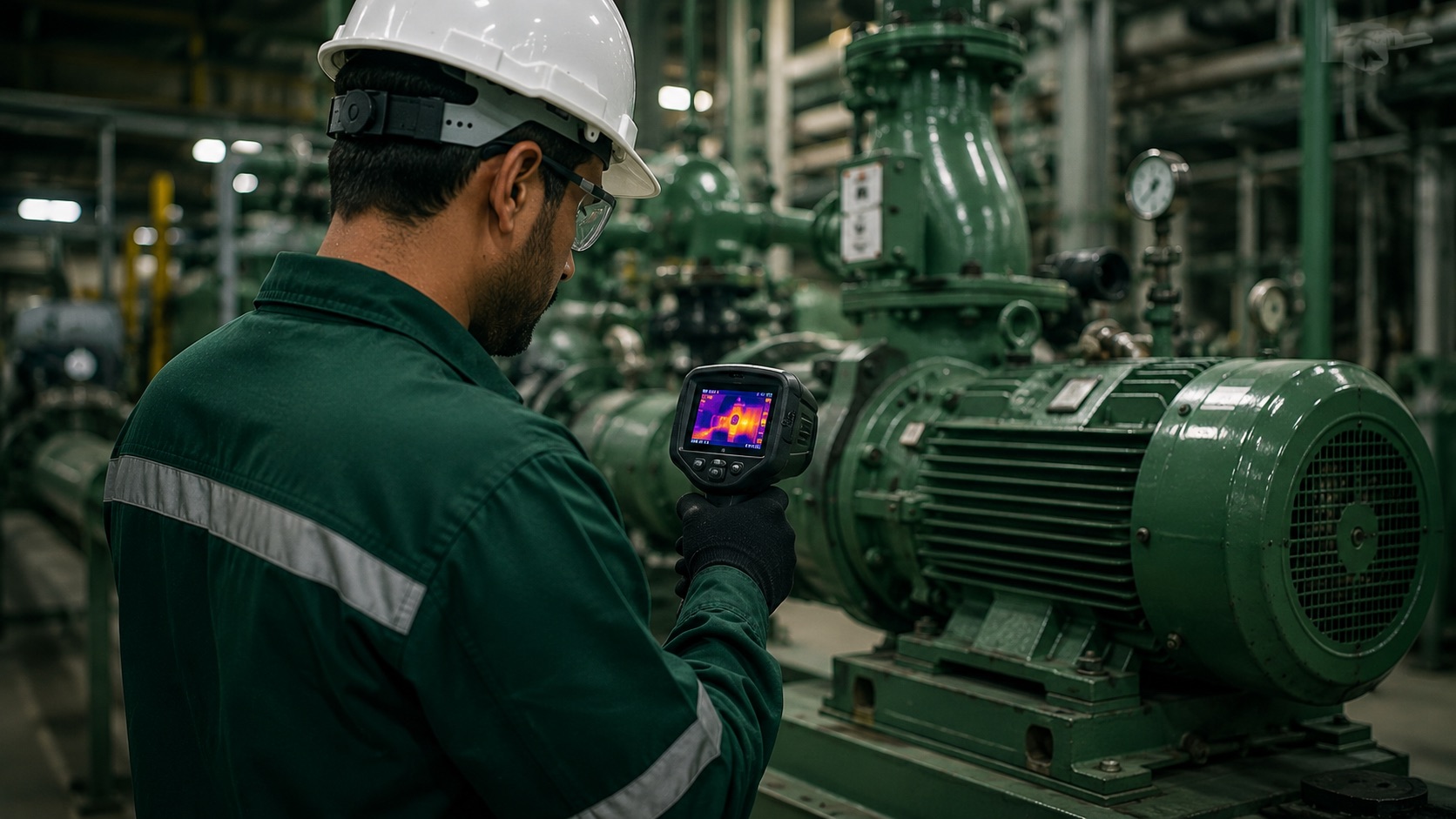
Thermal Imaging (Infrared Thermography)
Infrared cameras detect temperature anomalies invisible to the naked eye. Applications include:
- Electrical systems: Hot spots in switchgear, loose connections, overloaded circuits, failing components — all generate heat before they fail visibly
- Mechanical equipment: Overheating bearings, friction points, lubrication failures
- Building envelope: Insulation gaps, moisture intrusion, HVAC system inefficiencies
Periodic thermographic surveys (quarterly or annual walk-throughs with an IR camera) are one of the highest-ROI CBM activities for facilities with significant electrical infrastructure. Many electrical fires are detectable weeks or months before they occur through thermographic inspection.
Oil Analysis
For hydraulic systems, gearboxes, compressors, and engines, oil analysis provides a detailed picture of both the lubricant condition and what is happening inside the machine:
- Particle counts reveal wear rate and type — different metals indicate different components wearing
- Viscosity and oxidation indicate lubricant degradation
- Water content suggests seal failure or condensation
- Additive depletion indicates when the lubricant has lost its protective properties
Oil analysis is particularly valuable for expensive assets where internal access is difficult or costly, such as large gearboxes, turbines, and hydraulic systems.
Acoustic Monitoring
Acoustic sensors detect sounds outside the normal human hearing range. Ultrasonic detection is used for:
- Compressed air and gas leaks: Leaks produce characteristic ultrasonic signatures detectable meters away
- Bearing and gear defects: Mechanical defects produce ultrasonic noise before vibration signatures become detectable at audible frequencies
- Steam trap failures: Leaking or failed-closed steam traps are reliably detected with ultrasonic equipment
Electrical Signature Analysis
Motor current signature analysis (MCSA) examines the electrical current drawn by a motor to identify mechanical and electrical faults without physical contact or disassembly. It can detect rotor bar defects, air gap eccentricity, and developing mechanical issues in the driven load — all from a current sensor on the power supply.
Process Parameter Monitoring
For process equipment, operational parameters themselves are condition indicators:
- Differential pressure across filters, strainers, and heat exchangers indicating fouling
- Flow rates and pressure drops in pumping systems indicating wear or blockage
- Temperature differentials in heat exchangers indicating reduced thermal efficiency
- Power consumption in motors and compressors indicating increased load or degraded efficiency
These parameters are often already measured by process control systems and simply need to be routed to the maintenance monitoring system.
Implementing Condition-Based Maintenance: A Step-by-Step Approach
Step 1: Criticality Assessment
Before deploying any sensor, assess which assets justify the investment. Score each asset on:
- Consequence of failure (production impact, safety impact, environmental impact)
- Probability of failure (age, condition, failure history)
- Detectability (how much warning do failures typically give?)
- Maintenance cost history
High-criticality assets with variable degradation rates and detectable failure modes are the best CBM candidates.
Step 2: Failure Mode Analysis
For each priority asset, identify the specific failure modes you want to detect and map each failure mode to the sensing technology that can detect it earliest. A centrifugal pump might have bearing failure modes (vibration), seal failure modes (visual inspection plus flow monitoring), and impeller wear modes (differential pressure and flow).
Step 3: Define the P-F Interval and Monitoring Frequency
The P-F interval determines how frequently you need to monitor. If vibration analysis can detect a bearing defect six weeks before failure, monthly vibration readings are adequate. If the P-F interval is only 72 hours, continuous monitoring is required.
For most rotating equipment, the P-F intervals for common failure modes are:
- Vibration-detectable bearing defects: 2-8 weeks
- Thermographic electrical hot spots: 1-6 months
- Oil analysis particle anomalies: 4-12 weeks
Step 4: Establish Baselines and Alert Thresholds
Condition monitoring is meaningless without a baseline. Record initial readings on healthy equipment and establish alert thresholds based on:
- Manufacturer specifications
- Industry standards (ISO 10816 for vibration, for example)
- Statistical deviation from the asset's own historical baseline
Set two threshold levels: a warning level that triggers increased monitoring frequency and a danger level that triggers immediate action.
Step 5: Integrate With Your CMMS
Sensor alerts should flow directly into the CMMS as work orders or inspection requests — not sit in a separate monitoring system that requires manual transfer. When a vibration sensor exceeds the warning threshold, a condition-monitoring work order should be automatically generated, assigned to a qualified technician, and tracked to resolution.
Step 6: Analyze and Refine
Track the ratio of condition-triggered work orders to actual findings. If a high percentage of alerts result in no actionable finding, thresholds may be too sensitive. If equipment is failing between monitoring cycles, either the monitoring frequency or the threshold needs adjustment.
When Condition-Based Maintenance Is Overkill
CBM is not the right answer for every asset. It is likely overkill when:
- The asset is inexpensive and easily replaced: The cost of sensors and analysis exceeds the cost of simply replacing the equipment when it fails
- The failure mode is not detectable in advance: Some failures occur without a detectable precursor at any economically practical monitoring frequency
- The consequence of failure is low: If the equipment is non-critical, redundant, or easily worked around, the investment in CBM does not produce sufficient return
- Regulatory requirements mandate fixed intervals: Some compliance frameworks require PM on a calendar basis regardless of condition
For these assets, time-based PM or run-to-failure remains the appropriate strategy.
The Role of AI in Condition-Based Maintenance
Manual analysis of vibration spectra, oil reports, and thermal images requires significant expertise. AI-assisted analysis changes this calculus by:
- Automatically identifying anomalous patterns in sensor data streams
- Correlating multiple data sources to reduce false positives
- Predicting remaining useful life based on degradation trends
- Learning the normal operating signature of each individual asset rather than applying generic thresholds
AI does not replace the need for experienced technicians to investigate and act on findings, but it dramatically extends the reach of condition monitoring programs by reducing the expertise required for first-level data interpretation.
Conclusion
Condition-based maintenance represents a fundamental shift from asking "when should we maintain this?" to asking "what is this equipment telling us?" It reduces unnecessary maintenance on healthy equipment, catches developing failures before they become catastrophic, and improves the return on every maintenance dollar spent.
Implementing CBM successfully requires the right assets (high criticality, detectable failure modes, variable degradation rates), the right sensors for each failure mode, and a CMMS that connects sensor alerts to maintenance action without manual intervention.
FacilityLane supports condition-based maintenance natively — with IoT integration across MQTT, Modbus, BACnet, and OPC-UA protocols, threshold-based alert configuration, automatic work order generation from condition triggers, and AI-powered anomaly detection. Whether you are starting with a handful of critical assets or scaling across an entire facility, FacilityLane provides the infrastructure to make CBM a practical reality.
Contact our team to discuss how CBM can be implemented in your specific environment.